Showing posts with label maac animation. Show all posts

Tuesday, 4 September 2018

The Position of Storyboard Artist In Industry

MAAC Kolkata has brought before you a bag of interesting facts and elements about the position the storyboard artist have in animation industry.


This time it hasn’t missed the ‘unique’ factor about it.

A storyboard artist resembles the chief of an animated film or TV appears.

The artist makes visuals for each significant scene in the story including character postures, outward appearances, and foundations.

Each storyboard is comprised of boards and the artist draws all the vital boards including activity bearings, similar to when a character lifts their arm or when a character leaves the scene.

At times the storyboard artist gets a content and needs to draw the story as-scripted.

Be that as it may, ordinarily, particularly in TV series, the storyboard artist is likewise the author of the scene.

The artist can incorporate visual muffles and exchange to include their vision into the story.

This makes storyboarding a lucrative vocation for anybody inspired by the workmanship, coordinating, and narrating.

Be that as it may, storyboard artist can be utilized as a part of any advanced item including computer games.

Numerous diversions have cutscenes or rehash character developments that should be envisioned through sheets.


A great many people think about board work through cartoons since that is the means by which they’re made.

Each scene needs a storyboard to direct planning, camera shots/container, and character postures.

Activity moves quickly so every great storyboard experts should be brisk.

This implies a specialist level of draftsmanship for arranging and posturing characters in a scene.

Customary activity utilized storyboard boards drawn on paper.

One 22-minute scene could without much of a stretch be many sheets of storyboards just to recount the story.


There’s a cool scaled down doc from Pixar demonstrating their procedure for storyboarding highlight films.

On the off chance that you need to wind up a storyboard artist you’ll be a genuine decent sketcher.

You’ll require a phenomenal handle of the point of view and figure drawing for posturing characters precisely.

What’s more, you’ll be OK exchanging between various styles of workmanship as you move between appears.

A storyboard for SpongeBob will have an altogether different creative style than a storyboard for Adventure Time.

As a rule, you’ll have to face the basics and be fast with them.


Be that as it may, storyboard specialists once in a while work in shading so that won’t be as imperative.

In case you’re past the basics and need to dig directly into blocking at that point certainly pick a couple of books from our prescribed rundown for storyboarders.

That post ought to have all that you’ll ever need to find out about the organization, arranging, camera edges, posturing, and all the related complexities of drawing extraordinary sheets.

You’ll likewise require some tolerance and an eagerness to crush.

It takes diligent work to go anyplace in media outlets.


In any case, storyboarding can be such a breathing life into the process, to the point that for some individuals it’s justified regardless of the exertion.

Particularly in the event that you have a profound energy for both art and narrating.

Art and artists can never be separated just as the storyboard artists from the story.

Being a storyboard artist, you should have the capability to draw anything that is given to you as a task or project.

A Storyboard artist has a vast scope of opportunities in diverse sectors of Advertising, Live-action films, and Animation.

Advertising

The Storyboard artist can find its career actively in the field of advertising.

The Storyboard artist in advertising is utilized to produce an illustration of what the story of the TV commercial or the soap will look like.

This is done so as to influence, persuade and engage the customers in order to buy the concept being pitched.

Well, the set of illustration is prepared either when the brand agency is making efforts to win the customer’s business or the time when the client has already signed the agreement on the agency-brand.

Whatever may be the case, the significant element on the part of the storyboard is to envisage for the customer what the brand’s creative director or ‘creatives’ are contemplating and this is the blueprint to sell the customer’s product.

A storyboard artist may likewise be solicited to outwardly speak to a few adaptations from a crusade for print advertisements.

Live-action Film


On the front of the live-action film, a storyboard artist is employed at the very beginning of a project.

The time when a storyboard artist is contracted by a movie organization, the artist must separate the scenes of the content into shots which can be taped.

This is done under the supervision of the movie’s executive keeping in mind the end goal to guarantee the chief’s vision from the beginning of the venture.

As the creation continues, the storyboards are displayed to the cinematographer who is then in charge of conveying that vision to the screen.

The production organizations of the film may likewise contract a storyboard artist to make cleaned introduction style storyboards (which may likewise incorporate sound)which can be utilized by an official maker to collect the cash to make the film.

Animation


In case of Animation, project assignments are frequently addressed based on the fact of storyboards individually.

In this situation, the storyboard artists keep on to work all the way through the production in order to develop some specific scenes.

Subsequent to a scene which is edited the director along with the storyboard artists and the entire crew perhaps required to rewrite the succession, if required.

Want to engage oneself in the sea of Animation, layout, storyboard, Visual Effects, then MAAC Kolkata is the right choice for you.

Come here and register to get best results.

Tuesday, 31 July 2018

Explore the Colour Wheel Theory

Shading hypotheses make a consistent structure for shading.

For instance, in the event that we have a combination of leafy foods, we can arrange them by shading and place them on a circle that demonstrates the hues in connection with each other.

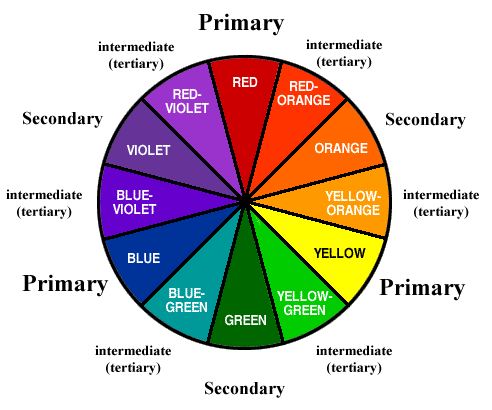
The Colour Wheel


As per the traditional art from the field of design, a color circle is based on red, yellow and blue.

The father of science, Sir Isaac Newton is the first person who developed the first circular diagram of colors in the year 1666.

From that time then, artists along with scientists have learned as well as designed plentiful variations of this concept.

Contrasts of feeling about the legitimacy of one arrangement over another keep on provoking open deliberation.

In actuality, any shading circle or colour wheel which exhibits a consistently orchestrated succession of unadulterated tints has justified.

Primary Essential Colours: Red, yellow and blue

In customary shading hypothesis, essential hues are the 3 shade hues that can’t be blended or shaped by any mix of different hues. Every other shading is gotten from these 3 hues of color.

Secondary Colours: Green, orange and purple


These are the hues framed by blending the essential hues.

Tertiary Colours: These are the hues framed by blending an essential and an auxiliary shading.

Colour Wheel Theory with Animation Kolkata

That is the reason the tint is a two-word name, for example, blue-green, red-violet, and yellow-orange.

What is Colour Harmony?


Now you might get confused that how harmony is related to colors.

Lets’ make it clear to you.

The phrase ‘Harmony‘ is referred to as a fascinating arrangement of portions, may it be color or poetry.

In visual encounters, concordance is something that is satisfying to the eye.

It connects with the watcher and it makes an inward feeling of the request, an adjust in the visual experience.

When something isn’t agreeable, it’s either exhausting or riotous.

At one outrageous is a visual affair that is bland to the point that the watcher isn’t locked in. The human cerebrum will dismiss under-fortifying data.

At the other extraordinary is a visual affair that is so overcompensated, so disordered that the watcher can’t remain to take a gander at it.

The human cerebrum rejects what it can’t sort out, what it can’t get it.

The visual undertaking requires that we introduce a coherent structure.

Shading harmony or colour harmony conveys visual intrigue and a feeling of a request.

In outline, outrageous solidarity prompts under-incitement, extraordinary unpredictability prompts over-incitement.

Amicability is a dynamic harmony.

Formulas of Colour Harmony

In the field of color harmony, there is the huge type of colour theories.

Present below are the descriptions of color harmony:

Colour Scheme based on Analogous colors


Analogous color is defined as any three colors which are cheek to cheek on a 12-part color wheel that comprises of yellow-green, yellow and yellow-orange.

But generally what happens is one of the colors prevails.

Colour Scheme based on Complementary colors


Reciprocal hues or complementary colours are any two hues which are straightforwardly inverse each other, for example, red and green and red-purple and yellow-green.

In the delineation above, there are a few varieties of yellow-green in the leaves and a few varieties of red-purple in the orchid.

These restricting hues make the greatest complexity and most extreme security.

Colour Scheme based on Nature


Nature is that part of the color that brings in an absolute departure point for the purpose of color harmony.

In some cases, red-yellow and green color makes a perfect combo in natural depictions.

Colour Context


Colour Context is how shading carries on in connection with different hues and shapes is an unpredictable region of shading hypothesis.

Think about the complex impacts of various shading foundations for a similar red square.

Red is one of the brightest colors and it shows much credible as well as radiant against a black background.

However, it is sometimes duller against a white background.

On the contrary to orange color, the red color seems unresponsive and in addition, it is also vital to mention that red, on contrary to green color exhibits brilliance.

For the red color, the background of black color appears more vibrant and large as compared to the other background colors.

So it can be concluded that a color wheel is effective in the visual representation of colors assembled as per their chromatic relationship.

A color wheel can be well analyzed and studied by means of positioning primary hues that is equivalent to one another and then generate a bridge or gap between the primaries utilizing secondary and tertiary colors.

Active and Passive Colours


The color wheel can be categorized into ranges and this two are visually active or passive.

When the active colors are placed against passive hues, active colors will seem to advance.

Propelling hues and tints are regularly thought to have less visual weight than the subsiding tones.

Regularly warm, soaked, light esteem tones are “dynamic” and outwardly progress.

Cool, low immersed, dim esteem tints are “latent” and outwardly subside.

Tints or tones with a low immersion seem lighter than shades or very soaked hues.

A few hues remain outwardly nonpartisan or apathetic.

Colour Relationships

Colour Relationships can be demonstrated as a color wheel or a color triangle.

Understanding colour relationship is it self a huge study.

The color triangle is the best way to make one get a better understanding of the color wheel theory.

The Colour Triangle of a Painter


It comprises of colors that people most frequently discussed in the art class concentrating on the three primary colors such as red, blue and yellow.

The Colour Triangle of a Printer

Colour Wheel Theory with Animation Kolkata

It is known for its set of colors utilized in the printing process.

In this case, the primary hues are magenta, cyan, and yellow.

The Nine-part harmonic triangle of Goethe


This part starts with the printer’s primary hues along with the secondary formations hues (painter’s hues) and the final tertiaries formed areas equivalent to dark neutral hues.

This blog post is presented by the global leader of Animation–Visual Effects–Web–Gaming, MAAC Kolkata with a view to educating the leaders about the different color wheel theories that are popular in the field of hues.

Tuesday, 26 June 2018

Assorted Facets of Colour Grading Software

Today’s blog post is about the different prospects of colour grading techniques in the Animation, Visual Effects and Multimedia.


Within the event that you aren’t a full-time colourist, probabilities are you might not plunge into any semblance of FilmLight’s Baselight, AutoDesk Flame’s Luster, or specific initiatives like REDCINE-X.

You’re likely simply searching for a speedy method to get comes about that fulfil your customer.

MAAC Kolkata is presenting this blog with a view to educating the readers about the diverse colour grading and colour correction techniques done through several colour grading plug-ins or software.

Here are a portion of the best projects and modules for video editors to influence a speedy shading to review.

DaVinci Resolve

Blackmagic’s DaVinci Resolve is one of the business guidelines for shading work. The reason it makes the rundown for video editors — the most recent rendition (12.5) incorporates an implicit NLE.

Blackmagic needs to end up the go-to put for everything after generation, and they are well on their approach to influencing DaVinci in order to determine a noteworthy program outside of shading circles.

DaVinci Resolve can be daunting, as the shading work is node-based — however there are a huge amount of instructional exercises on the web and the sum is developing.

Jumping into all the particular instruments requires an article significantly more top to bottom than this, yet here are a couple of devices for essential shading evaluating.

In the Color tab, you will be given an assortment of apparatuses.

This incorporates Color Match, Color Wheels, RGB Mixer, Curves, windows, and the sky is the limit from there.

The Color Match device works extraordinarily with shading outlines to right away match the condition the recording was shot in.

It will give you genuine nature comes about at the snap of a catch.

By the Color Match symbol, you will see the customary Color Wheels tab.

Primaries Wheels, Primaries Bars, and Log are present here that regulate the colour grading program.


The Primaries Wheels are the Color Wheels you will see in shading reviewing program. DaVinci Resolve utilizes Lift (shadows), Gamma (mid tones), Gain (features), and Offset.

Balance or offset is utilized to bring or lower everything up in each channel.

To control each wheel, simply drag the hover toward the shading you need.

Snappy note — DaVinci Resolve was intended to be utilized with a shading evaluating surface.


In case you don’t have $30,000 for the Advanced Panel, look at these more moderate shading evaluating instruments.

DaVinci Resolve 12.5 is accessible for nothing in the live rendition of the product.

Adobe Premiere Pro CC 2017


The Lumetri board has developed colossally in a previous couple of emphasis of Premiere Pro.

Initially a delayed impact, Premiere Pro CC 2017 has an all-out shading evaluating tab.

When entering the colour grading board, you will be met with all the customary Lumetri impacts, and in addition more conventional instruments like shading wheels.

The side boards are part of six default menus — Basic Correction, Creative, Curves, Color Wheels, HSL Secondary, and Vignette.

Each device works freely of each other, so changing the Creative shading wheels isn’t the same as changing the real Color Wheels.

The Basic Correction board enables you to utilize an Input LUT, change White Balance, Tone (exposure, differentiate, and so forth), and Saturation.

These are each controlled with sliders.

On the off chance that you don’t care for a modification, simply double tap the slider hover to reset.

The Creative menu permits to utilize.


Look records, which are particular to working in Lumetri.

On the off chance that you like a “look” you are taking a shot at, you can spare the modifications as a preset.

You can likewise download free look records to apply.

For quickness, whatever remains of the boards are fairly clear as crystal.

Bends or curves enable you to change RGB Curves and Hue Saturation.

You can likewise refine the picture with the Denoise and Blur choices.

Under Correction, you will see the first shading amendment instrument from Premiere, controlled by a solitary shading haggle shading sliders.

At last, Vignette alters the vignette.

Final Cut Pro X (Color Board)


With the most recent redesign of Final Cut Pro 10.3, Apple made an update to the whole face of the NLE — however, the shading reviewing stays comparative.

You should apply a Color Correction impact to a clasp, and afterward, utilize the Colour Grading Board to alter the look of the recording.

You will alter four pucks on the board — one each for Shadows, Midtones, Highlights, and Global.

The Colour Grading Board is incorporated with FCPX. FCPX is accessible for $299.

Shading-Colour Finale


What FCPX needs in shading reviewing, Color Finale compensates for.

This module is particular to FCPX, so on the off chance that you aren’t a Final Cut Pro X client — skip ahead.

Colour Grading  Finale is a result of Color Grading Central, which has an awesome group for everything shading reviewing related.

Colour Finale adds a free coasting window to FCPX.

Inside the window are Color Wheels, Color Sliders, Auto White Balance controls, and the Secondaries Vector apparatus.

The Pro form of Colour Grading Finale includes some work process administration apparatuses for those working in ACES.

Here’s a gander at the module in real life.

FilmConvert

Colour Grading with Animation Kolkata

FilmConvert is a copying programming that gives the advanced film a film feels with grain and shading impacts.

It takes a shot at a large number of NLEs and stages, including Premiere Pro, FCPX, Avid Media Composer, DaVinci Resolve, After Effects, Sony Vegas Pro, and as an independent stage.

There are additionally camera profiles for an assortment of cameras, like ARRI, Canon, Sony, Blackmagic, GoPro, and DJI.

Red Giant Magic Bullet Suite


Colorista is an independent shading evaluating module for Premiere Pro and After Effects.

By means of dragging the Colorista IV impact on your NLE timetable, you will get entry to a 3-wheel shading corrector, a guided work technique to regulate photographs, LUTs, RGB bends, shading key tool, skin overlays, and tone control.


It likewise coordinates itself with Adobe’s masking and tracking features/highlights.

Chances are you have known about Red Bullet Colorista, however, Colorista is very of the significantly bigger Magic Bullet Suite 13.

The greater part of the accompanying can likewise be obtained exclusively or together with the Magic Bullet Suite.

Looks enable you to shading right and apply prevalent TV looks in seconds.

Magic is like Looks in that it applies famous looks promptly, however, Mojo conveys true to life looks, sports recordings, and old films.

Denoiser evacuates noise and grain, and Renoiser includes true to life surface and film grain.

At long last, Cosmo is a stunner device, intended to apply advanced digital cosmetics and corrective cleanup.

Don’t hesitate to enter the world of colour grading.

Click here and register.

Sunday, 3 June 2018

Fully Utilize Motion Graphics To Enhance Animation

In our today’s blog, we are going to discuss how Motion Graphics is helpful and crucial in the Animation industry.

The Animation industry has turned out to be famous across the entire globe because of the consistently developing web and digitalization in the market.


There are several types of Animation that were once utilized just for particular errands are currently being utilized as a part of various fields.

Motion Graphics is one of the sorts of Animation that are utilized all the time right now.

The blog is presented by the MAAC Kolkata with a view to acknowledging the readers about the necessaries of the Motion Graphics in Animation and its facets while working on it.

Motion Graphics animation kolkata

‘Motion Graphics’ just means illustrations or graphics that seem to move around.

At the point when there were no computers and web, making a motion graphics video was troublesome and exorbitant, and these Animations were just utilized as a part of movies and TV programs.

Presently, with computers encouraging the errand of making these Animations, they are finding numerous utilizations all through the UK and around the world.

The most unmistakable utilization of these Animations has been in movies and TV.

The titles of movies, shows and other television programs are for the most part made utilizing Motion Graphics.

Utilization of Motion Graphics


Motion Graphics are additionally used to make subtitles and credits in TV projects and movies.

Marketing is a field in which distinctive sorts of Animations have discovered use.

Motion Graphics are utilized as a part of showcasing to educate clients as well as users about the various highlights and features of an item.

These Animations are great at catching the consideration of watchers.

Along these lines, the commercial message comes to even those individuals who have the most brief of abilities to focus.

There are certain websites that additionally utilize Motion Graphics in plenitude.

Animations help increment the time watchers spend on a site.


This is the reason why most organizations in London have no less than one of these Animation motions on their sites.

Motion Graphics designs are likewise utilized as a part of introductions to make them fascinating.

The measurements and assumes that is utilized as a part of Business to Business correspondence introductions make them extremely exhausting.

The uncovered insights in these introductions are made innovative and fascinating with the utilization of Motion Graphics Animations.

Instruction is likewise a zone in which these Animations are utilized.

These Animations are additionally used to pass on messages like ecological worries to individuals in a way that is speaking to them.

On the front of Motion Graphics and Animations, there are numerous applications that make it simple to make Motion Graphics Animation.

Macromedia Flash is the most surely understood application that permits making and transferring motion realistic Animations on the web.

Indeed, even customary individuals with small preparing can utilize the application to make delightful Motion Graphics groupings.


Individuals make these Animations for entertainment only and transfer them on the web and offer them with their companions.

A Motion Graphics organization makes proficient quality recordings that are utilized for item marketing, showcasing and portraying highlights of an item or administration.

A Motion Graphics studio likewise makes Animations for movies and TV programs that are utilized as a part of their titles and credits.

The universe of designing and planning has developed essentially finished the years.

The illustrations have made considerable progress from being only a plan highlight to picking up motion.

Together with sound, these realistic movements are utilized for extensive media assignments yet their survey encounter depends generally on the nature of designs.

Because of their adaptability, Motion Graphics video generation is exceptionally prevalent nowadays.


Motion Graphics are effectively versatile to a wide range of enterprises and parts.

They can make social mindfulness on imperative issues by utilizing lighter illustrations or graphics.

They are usable in training segment, gaming, training, kids learning and so forth.

On the front of Marketing, Animation can set the correct tone for marking of any item.


At times, brands may even utilize Motion Graphics to repackage their image and make a moment mark review.

Publicists can likewise utilize this idea to advance their new items among potential clients or users.


With Motion Graphics designs, it winds up plainly less demanding to draw in watchers’ consideration than straightforward pictures or still illustrations.

This has been particularly more effective with the children as they now want to watch kid’s shows and entertainment shows as opposed to simply perusing the comic books.

Motion Graphics are likewise ending up progressively well known in educating and preparing designs.

Anything that utilizations vivified Animation recording video streams can be adapted effectively and turns out to be effortlessly recollected.

The cost of creating Animation recording video streams is significantly less expensive than delivering genuine video ones.

Animation video recordings are shot utilizing fewer characters, utilizing condition that can be worked in a studio.

Be that as it may, genuine recordings require a number of performers and diverse sort of gear to appear it.

The advertisers can make the message more straightforward by utilizing designs motion in their recordings.

The data turns out to be effectively fathomable as well as be displayed in a significantly more appealing way, which can be held longer by the potential clients.

The Finale


Motion Graphics designs are worked from the scratch, watching out for even the littlest detail.

This makes Animation recordings keener and neater.

Notwithstanding, genuine recordings are not generally capable catch the littlest detail of each character and in addition the encompassing.

You can change your Motion Graphics designs to suit the age gathering and the sort of group of onlookers you are taking into account.

They can be anything from a short video to an undeniable motion picture.

This flexibility enables the makers to grow more tasteful substance.

Now and then advertisers can hit the correct harmony with a potential group of onlookers by delivering vivified Motion Graphics that is a momentous achievement.

This achievement can take a brand to another level.

Now and again, even a little-animated film character can end up noticeably mainstream with the gathering of people which the organization can control to present comparing stock.


As the Motion Graphics picked up ubiquity, a number of studios came up that guarantee you quality animated films and recordings.

It is vital to do your research examination a long time before you enlist one for your task.

Are you seeking for an effective teaching in all these relevant areas?

Then you have come at the right place.

Our centre offers placement guarantee and premier faculties that in turn helps you to meet your end goal at the end of the courses click here to know more.

Tuesday, 1 August 2017

The Evolution of Animation & VFX In Indian Cinema

On one’s way to work or school, waiting for transport. The auto that takes you where you want not only provides a means of travel, but some music as well, some of Bollywood’s golden age tunes. In our today’s blog we will discuss about the evolution of Animation and VFX in Indian Cinema, popularly known as Bollywood.

As you go, you see posters showing off the newest star’s upcoming film. Films are not just entertainment here: they’re a part of life. Students, professionals, parents, grandparents: everyone in the country is united by the love of cinema.


As of 2013, India ranks first in the world in terms of annual film output. In 2016, the industry’s gross box office earnings came to 15,500 crore (US$2.4 billion).

The prospect of foreign direct investment has made the industry attractive to the likes of 20th Century Fox, Warner Bros and Walt Disney Pictures while Indian companies such as Zee, UTV and many others continue to grow and expand. Cinema is nothing short of a financial and cultural force in today’s day and age.

That being said, one of the reasons why we love films is because they’re inherently unreal.

A great artist is able to portray something impossible in a way that makes you believe it isn’t.

In the context of films, this is achieved through the use of Visual Effects (VFX) and 3D Computer Generated Imagery (CGI). Some films are so far into the realm of the imaginary, that the only way to produce them is in an entirely animated medium.

Without further ado, let’s take a look at the evolution of film in India, especially with regards to VFX and CGI.


While there had been films made in India earlier, they are generally not considered part of our film canon. It was Dadasaheb Phalke, who, with his landmark film Raja Harishchandra, began the legacy of Indian cinema in 1913, and is thus called the father of Indian cinema.

Still struggling to overthrow the British regime, many films at the time had tones of nationalism, and stirred the people to action. It was a show of art’s ability to inspire people and transform lives.

It was also Dadasaheb Phalke who first experimented with animation in India.

His 1912 shot film The Growth of a Pea Plant was based on the concept of time lapse photography, with one frame shot per day. Subsequently, in 1915, he produced Agkadyanchi Mouj (Matchsticks’ Fun).

Later, he followed with Laxmicha Galicha (animated coins), and Vichitra Shilpa (inanimate animation) 1934 saw the release of the first Indian animated film to have a soundtrack: On a Moonlit Night.

The same year also saw the first animated film to get a theatrical release, The Pea Brothers. It was directed by Gunamoy Banerjee and produced by New Theatres Limited.

The film used drawn black and white images. The plot revolved around a pea pod that opens up to release peas, from which rise toy-like figures that play with each other. The film was an experimental attempt.

The 1940s were a decade that changed the world. They saw India win her Independence. They saw the world ravaged by World War II. In the world of Indian cinema, they saw filmmakers become bolder than ever before.

One of the major focuses of animation as a medium is being lifelike. While animation revels in exaggeration, it is ultimately based on real life, and thus, realism is one of the cornerstones of any good film, no matter how unreal or fantastic it may be.


It was only after 1977 that the world truly became aware of the importance of the visual aspect of a film, and the importance of realism in the depiction of unusual scenes.


With the release of Star Wars: a New Hope, John Dykstra, special effects designer, and his team pioneered from scratch the technology and techniques of depicting large scale science fiction landscapes, battles and explosions.

Their achievement was nothing short of revolutionary, and would change the special effects landscape for all time.

As a matter of fact, CGI already existed and had been used in Futureworld, which had debuted a year earlier.

It was, however, a method still in its infancy, not yet capable of bringing to life George Lucas’ imagined world. No, that would happen in 1993, with the release of Jurassic Park.

It was the first film to utilize CGI at a level that completely blurred the line between fiction and reality: when those dinosaurs moved, the audience believed.


The impact of these films on the country’s cinematic landscape was massive: not only were visual effects now used to conveniently allow the addition of scenes which would have been considerably more expensive to physically shoot in entirety.

With the building of props, or going on location, but they also introduced the idea of the science fiction film which was based on things that simply couldn’t be depicted without these technologies.

The implementation and rise of CGI and VFX in the Indian cinematic industry was something arrived at through a long road. From the early 2D animated films of the 30s, we had progressed to an age where video editing and CGI software was available to us.

The first fully Animated feature length film to be made in India was Pandavas: The Five Warriors, in 2000, directed by Usha Ganesh Raja and produced by Pentamedia Graphics.


At the time, it was lauded for what it had achieved. It was a winner of the Second Best Animated Feature Film Award in Vancouver Effects & Animation Festival, 2001, as well as the National Film Award for Best Feature Film in English.


Ramayana is the directorial debut of Chetan Desai, the chairman and managing director of Maya Digital Media on 15 October 2010.

More than 400 crewmembers where 80% of members was from MAAC worked on the film over a five-year period the first three years were spent designing the characters, while the other two were devoted to actual production.


Since then, both hardware and software have come a long way. With an increasing percentage of the total number of shots in films utilizing VFX or CGI, the demand for skilled professionals increased. Films such as Dhoom 3, Bhaag Milkha Bhaag and Om Shanti Om showed that India had made significant strides in the field.


In 2015, we saw the release of Baahubali: The Beginning. On many levels, this film was the litmus test for the VFX and CGI industry in India.

On a conceptual level, the film was a success, blending Indian mythology with Western flair and presenting a story that was engaging.

The film consists of a vast percentage of CGI, including 2500 VFX shots. Makuta VFX was chosen as the principal visual effects provider, responsible for a large amount of the CGI.

Much of the work involved creating a 1500 feet waterfall, along with mountains, landscapes and the kingdom of Mahishmati.

Creating the waterfall took a staggering 2 years, owing to the complexity of the fluid dynamics and simulations involved.

Firefly Creative Studio worked on the avalanche and the war sequences, along with some underwater VFX shots.

This was also the first time an Indian movie had used Academy Color Encoding System workflows along with Infinitely Scalable Information Storage keeping in mind the scale of the digitally enhanced shots in the film.

Arka Media Works teamed with AMD, utilizing the state of the art FirePro GPUs W9100 and W8100 during post production, hardware capable of rendering 4K content in real time.
The film’s success, of course, speaks for itself.
So where next for Indian cinema?

With an endless possibility of new ideas and powerful next gen hardware capable of making it all real, the sky is the limit. And that’s where creators and artists come in.

With institutes such as MAAC training students in the nuances and skills necessary for the animation and vfx industry, more and more new voices are being added, and more and more stories are being told.

With industry specific softwares and courses designed to prepare students for professional work, where better to prepare for a career in CGI and VFX than at MAAC, As a certain someone once said, “To Infinity and beyond!”

Monday, 31 July 2017

A GUIDE TO MAKE YOUR OWN FILM ANIMATION SHORT FILM

In today’s blog we will discuss how can one make his own short animation film be it 2d animation or in 3d animation.

Art has been a point of fascination for mankind from the very beginning. From cave paintings in prehistoric times, to mixed media art in the present day, art has endured through time.

Art, however, does not only refer to single images – it also includes sequential images. Recent technology has enabled us to play such sequences of images and see the action ‘happening’ before us.

This phenomenon is popularly referred to as the motion picture or film (after the celluloid reels traditionally used to project the images).


Combining traditional art and the motion picture is the genre we know as animation films.

Animation, or the process of creating movement in otherwise unmoving elements, is a technique that has evolved from the days of drawing sequential images (called frames) to modern day digital 3D films.

In this article, let us take a look at how an animation film – be it hand-drawn 2D, or digital 2D or 3D – is made.


In any film, there are three stages of development: pre-production (when the film is planned out), production (when the film is created), and post-production (when the film is edited and polished into a finished product).

The same holds true for the animation film.


Pre-production: The first step to making an animation film is to decide on a story.

Unlike live action, where improvisation is possible, animation leaves no room for winging it.

The story does not have to follow any traditional structure, but it should ideally have a beginning, middle and end.

Conflict is also important – the character(s) being focused on in the story should come across a problem and find a solution or resolution by the end of the film.

The story, or plot, can follow any theme and while it does not need to be grand (or in more technical terms, epic), it should capture the viewer’s attention.

Once the story is set, the next step is to design the characters.

Your character could be anything from an inanimate object to an insect, human, dinosaur or even magical creatures.

The important thing here is to sketch out how the character looks from different angles and decide on their personality.

Draw it, him or her from different angles in various poses and costumes in order to understand what works and maintain consistency during production.

The third and most crucial part of pre-production for an animation film is to draw out the storyboard.


A storyboard is a series of images depicting the actions taking place in the film.

While it is not always used for live-action films, the storyboard is a must for any animation film.

Animation is a time-consuming process, because of which planning the visuals and action in advance in full detail is necessary to save time and effort.

Adding colour or background detail isn’t required unless demanded by the story; however, a lot of major production houses include background detail in their storyboards so that so detail is left undecided.

For each image (or frame) being drawn, also include any dialogue or effects (camera movements, shot to shot transition, etc.).

When a sequence of such images are placed in a slideshow and timed according to the action or dialogue, it produces a rough film called an animatic.

You can even add the transition and camera effects for a clearer idea of how your film is going to turn out. Animatics give a simple and comprehensive idea of how your film is going to unfold, and helps you gauge what scenes to or not to include in the final film.

Production: Once you have visualised your story in the form of a storyboard or animatic, it is time to decide how you want to realise the film. The most obvious choices are –

Hand-drawn 2D: Also called traditional or classical animation, hand-drawing your movie’s frames is how animation used to be done in the early days.

Classic films like Disney’s Snow White and the Seven Dwarfs were made in this way. A minimum of 10-12 frames have to be drawn for every second’s duration of the film, keeping continuity of action in mind.


Digital 2D: In the computer age, there is different software by developers like ToonBoom and Adobe which allow for easier 2D animation. For these, you simply need your background and characters designed and coded for movement (a process known as rigging), and you can use the software to add in the motion.

This sort of automation does produce more consistent output than hand-drawing (at least, as far as beginners or amateurs are involved), but can be limited in scope. Most modern 2D content is digital. Examples of films include The Iron Giant, Spirited Away.

Digital 3D: 3D animation is synonymous with names like Pixar. It is the kind of look and design we find in films like Toy Story, Roadside Romeo, Epic, or The Boss Baby. This is very time consuming and resource intensive, as 3D software like Autodesk Maya, Autodesk 3Ds Max and Blender require far more computation to render an output than 2D.

The end result, however, is well worth the effort.

Stop-motion: A less common style of producing an animation film is stop-motion.

It is done by making models of characters and scenes, and taking photographs of every frame after manually adjusting the model as per the required action.

The short film Balance, and the recent feature film Kubo and the Two Strings were made using this method.

Post-production: Once your film is ready and the shots rendered, it needs sound and arrangement.

All of this is done in the post production stage.

From editing (arranging the shots in order and adding necessary transitions) and adding in dialogue and sound effects, to compositing (combining the different layers of information like colour, depth, lighting and shadow) and colour correction to enhance the visuals, post-production determines the final impact of your film.

Now that you know how to make an animation film, give it a try!

And if you need further guidance on the intricacies of any of the three stages, do visit MAAC Chowringhee, Rashbehari, Kankurgachi .

And be a part of our courses in graphic and 2D design, 3D design and animation, and compositing and visual effects techniques (which are invaluable for good post-production)!