Showing posts with label best 3d animation and vfx institute. Show all posts

Thursday, 24 August 2017

How Maac Kolkata Helps Its Students To Crack Down Animation OR VFX Job Interview

Preparing for a job interview is very essential. Today we will discuss few more tips only at Maac Kolkata to crack animation or vfx interview.

You need to be fully prepared to get recruited. Interviews have been a nerve wrecking situation.


It isn’t that easy to impress and secure the dream job.

Nervousness, has it’s own place, among the candidates.

YOU NEED TO OVERCOME IT AND GIVE YOUR BEST.

Preparing yourself for the interviews requires a lot of efforts, both for the fresher’s and the experienced ones.

Ease out your stress and prepare yourself for the interview.

Keep it in mind, there are many other people applying for the same job you have applied for.

So you need to control your nerves and DON’T PANIC, rather be chilled and confident.


If you are aspiring a career in Animation or visual effects and want to soar high in this field, you surely need world class training by experts, which you will get undoubtedly in Maya Academy of Advanced Cinematics – Maac Kolkata.


You need to enhance your creative talent and prepare yourself mentally to get what you deserve.

Maac Kolkata helps its students to prepare themselves for their future and also prepares them for all type of challenges they need to face in their career.

Facing an interview and cracking it is the first challenge for which the students are prepared during their course.

VFX and Animation industry is a blooming one. The demand for visual effects and other type of cinematic effects has increased greatly.

This increase in demand is a good news as more and more artists are being hired and getting their deserved recognition in this field.

If you are really talented and have the required skills then you have the chance to show off the world your ability.

Here, interview is the way to judge or analyse your skills as claimed by you in your resume and showreel.

There are few techniques you should follow and a few things you show keep in mind for securing your dream job in this world of Animation and VFX.

SHOWREEL


The first and foremost thing, based on which you are called for the interview, is your showreel.

For an animator or a VFX artist it is very important to prepare a good showreel containing your best works.

What a CV is to the people of other fields, a showreel is to the animators and VFX artists.

It is the first thing on the basis of which you are judged. A short yet impactful showreel is what you must prepare to impress your employer.

A carefully edited video with a subtle music and obviously, comprising your best works are the things you need to make your showreel worthy to be selected.

Please, make sure, you do not mess up your showreel, by adding works which are not required for the job you are applying for.

If you are applying for a job of Matte Painter, there is no need to add motion graphics work, instead focus on creating magnificent matte paintings and add them in your showreel.

INTROSPECTION


You should think and take your time beforehand, to introspect.

You must know you key skills. You must know your area of excellence and should know your forte.

Obviously, you can do many things but you have to focus on your specialised skill and work out on that. From a diverse range of aspects, like Modelling and Texturing, Lighting, Compositing, Animation, Matte Painting, Tracking, Rigging, etc, you need to choose one.

In a production house there are different departments and each department is expected to give their best output.

So you need to prepare yourself in that way. Suppose you are very good in Modelling and Texturing, prepare yourself to become the best 3d artist.

If you belong to Maac Kolkata, you need not worry about choosing your specialisation, as they know it best and know how to bring it out in an individual seeking a career in this field.

UNDERSTANDING THE JOB


People have the necessity to secure a job and establish themselves.

But do not apply for a job randomly, just because you need one. You need to be very clear about the job you are applying for.

Do some basic homework and research about the job.

Suppose you are very good in motion graphics, go for that job, and do not opt for any other specialisation, as you won’t be able to give your best in that.

Also you need to understand the requirements.

As an animator or a VFX artist you need to be very fluent in every software, that is required in that specific area.

If you are applying for the job of animator, you must possess good knowledge of the Animation Principle; Aesthetic n software’s required in it, like AutoDesk Maya, AutoDesk Max etc. You need to work harder and polish your skills.

You need to have enough knowledge so that when you are asked about it, you can answer promptly.

Also keep yourself updated with the changing needs and requirements so that you never seem backdated to your employer.

As a student of Maac Kolkata, you get the opportunity to understand the job requirements better as you get the opportunity to interact with highly professional faculty and industry experts.

ETHICS


You need to be honest about your skills and achievements to your prospective employer.

In the interview do not boast about your skills. You should not seem over confident or know-it-all, as it would only put a bad impression on your interviewer.

Always answer back politely. And never ever start a heated argument with the interviewer.

They may say things of different opinion and wait to see your reaction, so it might be their tactics to see how you handle your seniors and how much you are capable of working under them.

“Smile, give a firm handshake and stay calm.” Remind yourself to give a firm handshake and a big smile.

A smile will boost your happiness and show your eagerness. Also, remind yourself to make solid eye contact with the interviewer.

All of these body language cues will lead the interviewer to see you as a more approachable candidate.

SALARY


In the interview, when you are asked about your salary expectations, don’t say a random amount.

You should do a research of salary expectations for the post you are applying for.

Saying a weird value on being asked your salary expectations will let the interviewer doubt your knowledge about this field.

Try to do a thorough research in the internet and also you may ask people from the field to provide their knowledge of salary expectations.

FEAR


It is very obvious to get nervous in the interview process.

Everyone knows how difficult it is to get selected. It is really a hard thing to have the ability to impress others.

You might be very talented in your field but the FEAR would be a great hindrance in the path of you securing a job.

The fear of getting rejected or facing the interviewers is a major drawback. You must know to overcome it.

As an animator you might possess required skill and knowledge but lack of confidence in yourself and having the fear of rejection wouldn’t be good for you.

Try to handle stress in a calm way. Do not get panicked.

Just chill and focus on your skills. Have faith in yourself and believe your ability.

Noteworthy, the faculty of Maac Kolkata knows how to help you to overcome your fear.

They will help you to boost your confidence with thorough counselling.

Appraisals and recognition’s are the things you need to overcome your lack of confidence, which you will get in Maac Kolkata.

They leave no stone upturned to inspire you and motivate you and help you build your career.

Now that you have got some good tips, gear up for your career and be confident enough to crack the interview with ease.

“I can do this” are the words that will boost your confidence.

The last thing you want to do is go into the interview already thinking you’re not going to get the job.

Never set yourself up for a loss when you can always set yourself up for success.

Don’t think of the interview as the top of the mountain.

Instead, think of it as a stepping stone on your way to the top. This will ease off some of the pressure you may be feeling.

Think beyond the interview and look at your future.

How is this interview helping you get to where you want to be?

Go ahead and give your best in the interview.

BEST OF LUCK!

Thursday, 20 July 2017

3D PRINTING: THE FUTURE OF TECHNOLOGY

3D Printing (also called additive manufacturing) refers to a number of techniques and processes used to create a three-dimensional object.

These objects can be of a huge range of shapes, sizes and geometry types, and are controlled by a computer that is fed 3D object data in what is termed as an AMF or Additive Manufacturing File.


Unlike the traditional machining processes where material is removed from a stock, 3D printing or AM builds a three-dimensional object layer by layer using the information fed to it via a computer-aided design (CAD) or AMF file.

Originally, the process known as 3D printing involved depositing a binder material layer by layer onto a powder bed using inkjet printer heads. It was associated with polymer or plastic technologies, whereas additive manufacturing or AM was used for metalwork and other such production contexts.

‘Additive manufacturing’ emerged as an umbrella term in the early 2000s, while ‘3D printing’ gained traction among the masses due to its use by consumer-oriented producers.

Lower-end machines (either in terms of capability or price) have been historically associated with it, and AM is the preferred term in formal or industrial manufacture, due to the basic nature of the process: sequential layer addition to create a 3D object under computer control.


The earliest additive manufacturing technologies, materials, and equipment were developed in Japan in 1981.

Hideo Kodama invented a method for fabricating three-dimensional models using a light and temperature-sensitive polymer with the area of exposure being controlled by a mask pattern to give the object proper shape.

In 1986, Chuck Hull of 3D Systems in the USA patented his process of stereo lithography, which is a type of 3D printing technology that uses light-sensitive (photopolymerisation).

His technology is used even today for digital slicing of CAD models and infill strategies to construct the physical object.


He is also the mastermind behind the STL (Stereolithography) file format in printers that use the photopolymerisation technique.

In 1988, S. Scott Crump of Stratasys developed the plastic extrusion technique of fused deposition modelling (FDM), and the first machine to employ this method was available for sale in 1992.

3D printing in the sense of powder beds being shaped by polymers was first invented at the Massachusetts Institute of Technology in the USA and commercialised by the products of Z Corporation in 1993.

In the same year, Solidscape introduced a high-precision polymer jet fabrication system with a ‘dot-on-dot’ system of soluble support structures for the model being printed.

In this period, AM for metal structures was done through automation, but using (as they came to be called in recent times) subtractive or non-additive methods such as sintering, casting, fabrication, melting.


These were known by their own names, such as direct metal laser sintering, or selective laser melting).

The concept of a tool head moving to generate a shape layer as per one’s desire was associated in the metalwork industry with processes that removed metal rather than used it.

By the mid 1990s, this was being challenged through developments at educational institutes in the USA such as Stanford University and Carnegie Mellon University where engineering techniques like micro casting and spraying were being developed.

Sacrificial or support materials were also becoming more common, thereby enabling the design of new, complex kinds of geometry.

However, it was in the 2010s that such metal casting was done. Car parts like engine brackets and large nuts were created though additive manufacturing rather than being machined from stock, and major manufacturers like the Swedish company Koenigsegg have used 3D printed parts in their cars (notably the Koenigsegg One:1, a supercar).


3D printing is also used extensively in the medical field for producing custom casts and prosthetics.

3D models for printing may be made using computer aided design, or by 3D scanning.

The advantage that CAD has is that the modeller has complete control over the output and models can be made with a very high degree of accuracy.

Further, if there are any errors of intersection, face normal, or noise shells causing problems when the models is sliced for printing, they can be easily adjusted.

On the other hand, 3D scanning collects digital data on the shape of an existing object and renders a digital model based on that data.

As 3D scanning is dependent on point-to-point data collected by the camera, these errors are more likely to occur when reconstructed in a digital geometry.

After the model is complete, the data is converted to the STL file format, and then digitally sliced the model into ultra-thin layers in a G-code file, using which the printer does its work.

Printers are available in different resolutions, and this factor defines  printing ability and price of the machine.

Typical layer thickness is around 100µm (around 250 dots per inch), with some printers capable of printing 16µm (about 1600 dots per inch). XY resolution is comparable to that of laser printers, with an average range of 100-300 DPI.

In three dimensions, the 3D particles of the objects are typically 50-100µm (510-250 dots per inch) in diameter.

Construction of a model can take anywhere between a few minutes to several days, depending on the size and complexity of the object being printed, the type of machine used, and the number of models being printed simultaneously.

The most significant advantage that additive manufacturing holds over traditional engineering methods like injection moulding is the reduction in the time taken to produce a finished product.

Recently, MAAC Chowringhee, Kankurgachi, Rashbehari had organized a seminar for students on 3D printing.


It was an interesting and educational experience, and the students got to see a small model of (?) being printed during the session.

3D printing Maac Kolkata3D printing Maac Kolkata.


An FDM type printer was used, and the speaker explained that these are more common due to the versatility of thermopolymers, which is the material used in most lower and mid-range printers: they can be shaped easily through the use of heat and the printer head can produce models of great precision and complexity.


The students were also shown other models that the speaker’s company had made, along with a presentation highlighting the different applications of 3D printing.

In addition to engineering, scientific and medical applications, they are also used for previewing conceptual prototypes before actual production, as it is less expensive than producing a product directly.

The bottom line: 3D printing is the future of design, and there great potential for development.

Thursday, 6 July 2017

BEYOND BORDERS: INDIA AS AN ANIMATION & VFX HUB

Visual effects (VFX) and animation are today synonymous with films, and there are numerous techniques that have been developed and are in use to make the output more attractive and easier to create.

We have moved from relying solely on practical and physical effects to seamlessly integrating computer generated imagery (CGI) to create the extraordinary.

When we think of VFX or animation, the first name that comes to mind is Hollywood.

This is not without reason with names like Disney (the first major player in the animation film world), Pixar (which produced thse first computer based 3D animation feature film, Toy Story), Rhythm & Hues (the name behind the VFX for The Golden Compass and Life of Pi, both of which won awards for visual effects).

Moving Picture Company (recent and upcoming VFX work in Alien: Covenant, Passengers, Pirates of the Carribean: Dead Men Tell No Tales, Transformers: The Last Knight). But what might surprise you is that a lot of the work that you see in these films was, in fact, done by Indians in India!

Most of us never see the credits list at the end of a film, but if you have, you will know what we are talking about. This is because of the trend of outsourcing, or obtaining goods and/or services from an external supplier that is gaining traction in the entertainment industry lately.


Let us take a look at the reasons why India is a prime choice for outsourcing animation work from Hollywood.

Strong technical background: It is certainly not without reason that India has established itself as a breeding ground for capable workers in technical fields like engineering and the sciences.
Historically, there has been a mentality that one should ‘be a doctor or engineer to be successful’ and it can even be said that us Indians have a knack for the technical in our genes.
As far as creativity goes, too, we are not lacking. In the film world, the Indian film industry produces near about a thousand films every year, and most of these (the numbers stand at around 75%) use VFX in some capacity or the other.

There are also a number of production houses that are well equipped with the kind of hardware needed to deliver high quality work; while most are domestic as far as the source of work goes, some are being targeted by international filmmakers who want their work to be done well.
The computer and digital content creation is the medium of choice for most studios these days, and with the recent political push towards internet based content consumption, and institutes of repute like MAAC Kolkata (Chowringhee | Rashbehari | Kakurgachi) to teach aspirants, there is a huge potential to tap from.

English-speaking workforce: With several billion speakers, English is possibly the most global language in today’s world. Also, it is the language of choice as far as computers, visual effects and animation are concerned.

This has a twofold impact – not only does it provide an advantage in the market by making content accessible to a worldwide audience, but it ensures that the people involved in creating visual effects and animation have as little difficulty as possible when using software to aid their work.
With its sizeable proportion of educated population coupled with the fact that English is one of the official languages used in the country, India has one of the largest populations of English speakers across the globe, and this gives us an edge over other countries that are hubs for outsourcing animation to.

Cost effectiveness: Level of skill and communication ability aside, the other important player that draws foreign productions to India is the relatively low cost of completing a production in our country.

To put things in perspective, animators and visual effects artists and studios in India require (on average) one fifth of the production cost that would be required for the same project to be completed in its home country.

Considering the market oriented nature of the world nowadays, this combination of low cost and high efficiency makes India a natural and top choice for foreign producers who want affordable and polished work in their productions.


Over the past few decades, animation and visual effects has slowly and steadily integrated itself into mainstream media – not only film, but also in television (most notably, cartoon programs), the advertisement industry (on the web, broadcast and print platforms) and the internet (through the advent of video on-demand services such as Amazon Prime and Netflix).

More and more major international players in the VFX and animation world are expanding their borders to either open a branch office for work in India (for example, Moving Picture Company or MPC, which most recently worked on the VFX for Disney’s live action feature of The Jungle Book, sourced most of its work through the Bengaluru office) or to start an Indian division (The Walt Disney Company, Dreamworks, Technicolor).

These are, for the most part, faring well with a favorable job outlook for aspirants to the world of animation and VFX.


As we learnt at the MAAC Manifest held recently at the Academy of Fine Arts, Kolkata, the visual effects and animation industry in India is booming like never before.

With the recent global proliferation of media content that uses intensive visual effects and animation, and socioeconomic measures in the country sending more and more people towards digital content; it is more and more imperative that we provide a high quality output. MAAC Chowringhee | Rashbehari | Kakurgachi can help you make the most of this trend by gaining you access to the requisite knowledge as well as placements in these studios.

In past years, our students have been successfully placed at major studios of international repute such as Prime Focus, Prana, NY VFXWALLA, Dreamworks, Technicolor, Disney, MPC, Rhythm & Hues and Pixar, in positions both of VFX and animation.

They have worked on blockbuster Hollywood films such as Life of Pi, Godzilla, Avengers and more. If working for one of these famous studios is your dream, then walk in to your nearest MAAC Kolkata centre today and get started on building your career today!

And remember… at the end of the day in the world of media, the only thing limiting you is your own imagination.

Friday, 10 March 2017

Disney: Animation To Live-Action

It all started with Alice in Wonderland. Then there was beautiful, Cinderella, and followed by the Jungle Book.

Let’s take a glance at ten mind blowing movies tat Walter Disney is popping into a live-action journey.

#1 Tink


Introduced to moving picture audiences in Peter Pan (1953), Tinker Bell is Disney’s unofficial mascot. We can see her presence in advertising, and Disney  Theme parks as well. She additionally has her own series of productive direct-to-video animated films.

Currently she is being prepared to hit the massive screen all over again, now in live-action.

A little bird, or could also be a trifle fairy, will be created with  lots of visual effects which will going to be spectacular viewing by recreating the magical  world of fairies.

We are curious to understand if the moving picture can work on an equivalent lines as Hook, a prequel to the first Peter Pan, and therefore the story of  Tinker Bell came to fulfill very little Peter.

#2 Prince Charming


 Have you ever noticed that the Walt Disney Princes seldom ever given a name? They’re largely ‘Prince Charming’, which is what Walt Disney is all ready to bring round the massive screen.

Not a lot of is understood regarding the project, however it’s been rumoured that the story are all regarding the Titular prince’s brother, a person who has been unable to measure up to the name, due to a definite lack of manners and ‘charm’.

#3 Genies


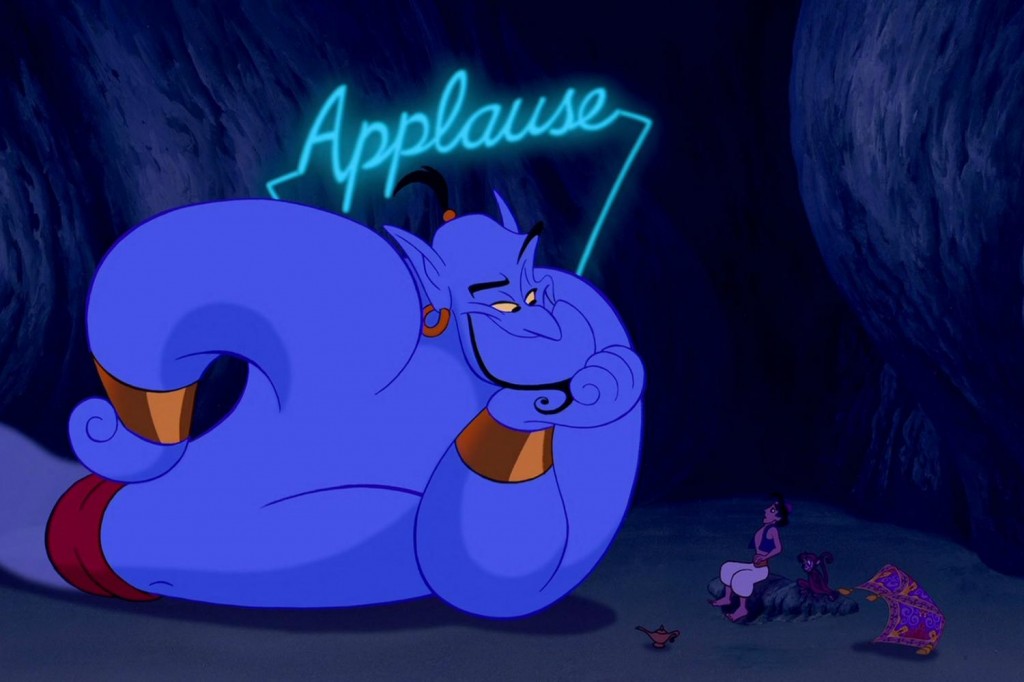
 Genie remains one amongst Disney’s most unforgettable & wanted characters until date.

And it’s about time that he got his own share of fame.

The story is set to be a sequel to Aladdin, and will show how Genie ended up in the magic lamp.

We can’t wait to know who fills the shoes of the legendary Robin Williams, the original voice of Genie in 1992.

Wait!!! Did you know, Disney is also planning a live-action remake of Aladdin?

#4 Cruella

Now who can forget Maleficent?

It seems Disney can’t forget the profits it made on the project, and is all set to create a Disney villain series, Cruella de Vil being the next in line.

The antagonist from 1961’s 101 Dalmatians will return to the big screen with her own story and charm.

Emma Stone is currently in talks to portray the younger, maybe-less-evil Cruella.

But she has the work of Glenn Close to live up to, who played the character in the live-action adaptation 101 Dalmatians & 102 Dalmatians.

#5 Pinocchio

Pinocchio taught us the perils of lying.

And he is coming back.

Although the animation was not a commercial success at the time of its release in 1940, the movie, and Pinocchio have gone on to become the face of childhood morals globally.

Rumour has it that this live-action will remain true to its animated original.

Let’s see if the sequence where Pinocchio gets drunk and smokes cigars with all the other little boys makes it out of the censor room.

#6 Winnie the Pooh


The introduction of almost every child to the world of stories, Winnie the Pooh continues to be a legend.

The film has had four theatrical films & countless television series.

Disney hopes that the magic will crossover from animation to live-action.

It is believed that this version will concentrate on an adult Christopher Robin returning to the Hundred Acre Wood and reconnecting with all his animal buddies.

We hope for some big screen extravaganza similar to The Jungle Book.

#7 Dumbo


Tim Burton will be directing this project. Need we say more?

What will be interesting to see is how Burton turns the original 64 minutes long story into a 90-minute feature.

We are hoping for some brand new material in this classic tale of an orphaned circus elephant that becomes a flying wonder.

But we have to say that this is quite an unexpected name in the list. Let’s keep our figure crossed.

#8 Chip ‘N Dale: Rescue Rangers

Chip ‘n vale have starred in a various range of theatrical shorts, and had their own television series – Chip ‘n Dale: Rescue Rangers.

The show had 2 mischievous chipmunks because the founders of an agency that, in conjunction with friends, would solve crimes.

We wish to see some off the crime stories, and if the detectives are our own  favourite Chipmunks, who’s complaining?

#9 The blade within the Stone


 We are glad indeed that somebody thought of revitalising this classic.

It remains one amongst the few Walt Disney films that ne’er saw any continuation, whether or not direct-to-video or within the theatres, except a short reference within the animation Beauty & the Beast.

Since we have a tendency to have to be compelled to grasp that Bryan Cogman, the tv author & producer who originally started with the Sport of Thrones, we have a tendency to square measure watching for some story-telling marvel to happen.

#10 Fantasia

This 1940 classic, supposed to be the come back of Irishman Mouse, introduced in eight totally different classic musical compositions.

Currently film maker is about to require one among st those segments and make a whole moving picture out of it. It’s rumored that the story can have an equivalent treatment as Maleficent.

Which Disney animation do you want to watch as live-action? Tell us in the comments below.


Thursday, 28 July 2016

Top VFX Studios In India

VFX is the process by which an image is created and changed outside the shot or surrounding or in other words VFX creates realistic environment by taking live action footage and another image generated in the  same environment which looks real in moving frames.Bollywood and Hollywood have been using this  technology to add glamour and realism in the movies. here is the list of  Top VFX Studios In India by MAAC Animation Kolkata , have a look : 


Red Chillies


Red Chillies.vfx is dedicated to bring innovative technology  and unmatched creativity for Indian cinema. The  company have proved itself by providing excellent visual effects for movies like Ra.One which had extensive  suit and face replacement and also digital set extention for a train crash sequence. Recently Shahrukh Khan  new venture Fan created lot of buzz when Shahrukh played the young man Gaurav Khanna of 20 year old  young man and at the same time he also portrayed the character of a superstar Aryan Khanna. Shahrukh was able to achieve the flawless look by going through hours of prosthetic makeup sessions and commendable job done by Red Chillies VFX team which took the reality to another level.


Prana


Prana is an Indian VFX studio have successfully brought dragons to life for the most talk about series of ‘Game of Thrones’. Prana studios have also worked on bollywood projects such as ‘Byomkesh Bakshi’ and ‘Bombay Velvet’.In ‘Transformers: Dark of the Moon’ Prana designed the destruction and fire FX ,rocket lift off  sequence and many other visual effects elements for the movie.


Tata Elxsi’s Visual Computing Labs (VCL)


Tata Elxsi’s Visual Computing Labs (VCL) with its headquarters located in Bangalore  is a leading name for  animation and visual effects in India.The company has gained recognition for its unmatched excellence in  movies like ‘Ek Tha Tiger’ , ‘Aparichit’ , ‘Jodha Akbar’ ‘Bhag Milkha Bhag’.


To add glamorous effect and to overcome practical barriers bollywood have been relying on VFX extensively. Futureworks have successfully created magic on screen by painting larger than life pictures for movies like’  Madras Café’,Lunch Box, ‘Boss’, ‘I’ and ‘Oh My God’.


Reliance mediaworks

Reliance mediaworks is one of the leading media and entertainment companies of India. It is located in  Mumbai and operates around 78 cities and towns in India and also has its roots in United Kingdom and  United States.


The company has been recognized for its work in motion pictures like Avengers, Dark Knight Rises, Bodyguard, House full 2,  etc.


Pixion


Pixion has been providing VFX for bollywood and many international TV commercials for a while now. Company has movies like Honeymoon Travels, Namastey London, Son of Sardar and Oscar nominated movies like Barfi in its kitty. Based in Mumbai Pixion delivered 160 VFX shots for Bhaag Milkha Bhaag where events  like partition of India, sports events like Olympics ,Asian and Commonwealth Games were recreated.


Dreamworks


Dreamworks have reset all the rules for storytelling with movies like How to Train Your Dragon 2 ,Kungfu Panda, In association with visual effects specialist Digital Domain Dreamwork is all set to jump into bringing Shrek  and Kungfu Panda to virtual reality.


MPC

MPC has created spectacular visual experiences in blockbuster movies like Godzilla, Harry potter series,   Martian, Batman, Pirates of the Caribbean, X men, Goosebumps, Life of Pi, and last but not the least Disney’s Jungle Book.They have been one of the global leaders in VFX for over 25 years and have been operating from bases in London, Mexico city,Los Angeles,Shanghai, New York, Montreal, Bangalore, and Amsterdam.


The company was founded in 2009 is located in Hyderabad,India.It provides visual effects services for motion pictures ,television serial and feature flims.The company also provides services in customized 3D animation and creation of storyboards, character and background in 2D environment.It has provided marvelous VFX work  for movies like Robo,Dabang, and Payanam (tamil movie) more than 400 VFX shots have been delivered by the VenSat team which included the avanlanche sequence on snow covered mountains.


Based in Mumbai Geon studios has recently delivered VFX for Tamil movie ‘Unnaipol Oruvan’ and Telugu movie ‘Eenadu’, having Kamal Hasan  in lead role which are the remakes of bollywood movie ‘A Wednesday’ released in 2008The thriller story  was meticulously enhanced using visual effects. Geon worked upon a total of 400 plus VFX shots.

The VFX team replaced and designed shots for name plate , TV monitors, rooftop gadgets ,windows etc. Also 3D  camera were extensively used with lot of composting work along with  digital matte painting and CG shots.


To learn more about the details and scope of VFX visit us at http://animationkolkata.com/


MAAC Chowringhee
Mobile: +91-9836321595
Email Id: chowringhee@maacmail.com

MAAC Kankurgachi
Mobile: +91-9830390356
Email Id: kankurgachi@maacmail.com

MAAC Rashbehari
Mobile: +91-9836321789
Email Id: rashbehari@maacmail.com

Wednesday, 27 July 2016

TOP 5 FAVOURITE ANIMATED CHARACTER IN THE WORLD

When it’s about animation age is no bar Animation has stolen everyone's heart. It may be kids, collage students or even parents or grandparents. Animation has focused every age has their target audience. Ask anybody about their favorite animation characters, they must be having at least one, with some funny memories.
Today we will be churning your memories and discuss about five most loved animated characters in the world.

Tom & Jerry

Tom & Jerry
Who all have not watched it? I am sure there is no one who has not seen this show at least once in their life span. This is one of the most favourite shows. Launched in 1940, this is one of the most famous and loved American animated series of short film made by William Hanna and Joseph Barbera. Tom a cat and Jerry a mouse, shows the rivalry in the show. 

 Micky Mouse

mickey-mouse-7
Another famous name Micky Mouse, again a favourite one. Micky mouse is a funny animation cartoon character and the official mascot of the Walt Disney Company. Micky Mouse was made in 1928 by Walt Disney and Ub Iwerks at the Walt Disney Studio.

Donald Duck 

donald-duck
Remember him? He was famous for his intelligible speech and his mischievous personalities. The character was created in 1934 by Walt Disney Production. Donald was an anthropomorphic white duck cartoon character with a yellow orange bill, legs and feets.

Snoopy                                                                                                      Snoopy                                               

Remember the white dog? I am sure yes. Snoopy can be found in all the peanut movies and television specials, like the peanuts movie. Since his debut in 1950, snoopy has become one of the most recognizable and iconic characters in the comic world.

Bugs Bunny

Bugs Bunny
The grey Rabbit with a carrot in hand famous for his flippant. Remember? Bugs Bunny was launched by the staff of Leon Schlesinger productions and voiced by Mel Blanc. Bugs is best known for his amazing role in Looney Tunes and Marrie Melodies.

These are just few of the famous, lovable and favourite animated characters, there are many more. If you get inspired by them and planning to give a birth to your own animated cartoon then join MAAC Kolkata and get trained in the field of animation. We work hard to get your dreams come true.
To learn further  visit us on:  animation kolkata