Showing posts with label animation Kolkata. Show all posts

Monday, 8 July 2019

Reason CGI Animation Becoming Popular Animation Technique

Hope you all know that CGI stands for Computer-Generated Imagery.


Today we will try to find out the reason behind the popularity of CGI animation technique.

Before CGI two animation techniques were very popular one is hand drawn Traditional Animation and other is Stop-Motion Animation.

In Traditional Animation artists used to draw the images on a transparent celluloid or cel.

Traditional artists used to place cels on top of the background image to create multi-layered frame.

And in case of Stop-Motion Animation clay model puppets were used.

But with the digital technology animation artists switched to computer screens instead of pen and paper.

Animators can now place 3D models easily in three-dimensional space and can make then interact with each other.

In the current scenario CGI animation technique has become popular and the other two techniques have taken back seat.

CGI Animation Took The Front Seat


In the year 1993 Jurassic Park Movie changed the face of movies and entertainment.

Jurassic park proved that CGI movie not only look good but can become popular also.

Computer generated Dinosaurs with real actors created a fantasy world both for the audience and film industry.

In case of Jurassic park dinosaur’s models were scanned with lasers and imported within the computer.

For the first time animator added movement to bare-boned, wireframe models of dinosaurs and the audience could watch something beyond their imagination.


Skins were added on the Dinosaurs with the help of 3D software.

Animators built the scene frame by frame with the software tools.

CGI allows the animator to create huge possibilities.

Various user friendly 3D software are available in the market today which helps the artist to model any figure of their choice.

Computer generated 3D models look very similar to the real life figure as because of the depth dimension.

Previously Traditional animated figures had only two dimension i.e length and breadth; depth got added to the figures due to the 3D technique.

As because computer generated 3D figures looks more close to the real life character both the animators and audiences is preferring CGI techniques.


Until 1990s CGI was used in a restricted manner but in 1995 movie Toy Story became the first full-length CGI feature.

3D software became more user friendly by the time of Toy Story thus allowing small team of animators to give life to the Woody Character.

Reduction in the price of computer allowed the animators to have their own digital set ups to work with images and animation.

Young talented artists get interested towards the digital technology and they find this CGI animation technique less painstaking.

CGI Modeling Technique


Autodesk Maya or 3D Max helps the animator to create any model using polygon meshes.

3D models are gaining popularity in the entertainment fields due to their closeness with the real figures.

Animators can give movements to each body parts of the computer generated models something which is possible only in the CGI animation technique.

Detailing in the wrinkle skins, a blink of an eye, a lip movement looks more realistic in the CGI animation techniques.

Development of RenderMan; a photorealistic 3D rendering software by Pixar Animation Studio added more advancement in 3D technology.

RenderMan facilitates communication between 3D model, animation and render engine to generate high quality images.

This rendering process has been used to provide stunning visual effects for Hollywood blockbuster movies.

CGI is non-linear in nature; animators can work on different parts at the same time; one team may work on body movement while another can work with facial expressions.

Background construction to lighting effects almost everything can be divided to different artists to speed up the big project.

CGI Fur and Cloth Simulation


One of the toughest works of animator is to animate hair or fur of the creature.

But this work also became easy when Pixar developed fur simulation program called Fizt; with Fizt program animators gave motion to Sulley’s fur in the movie Monsters Inc.

Fur Simulation allowed the animators to animate the body fur in more real manner.

With CGI animators can give detailing touch to every each and every body parts of creature or human.


Similar to Fur Simulation; CGI allows cloth simulation.

CGI allows cloth modeling in the 3D space; with cloth simulation artist can manipulate colour, texture and crease of the cloth to make it look like real cloth.

CGI Simulation process has become very popular now and it has taken the animation technique to the highly advanced stage.

CGI Simulation was quite impossible in the previous or hand drawn animation technique.

CGI Motion Capture Technique


Motion Capture is another CGI technique where performance of the actors can be recorded and transferred to the computer generated models.


This technique came to use in the year 2001 with the film The Lord of Rings where master of motion capture director Andy Serkis used this technique for the character Gollum.

Motion Capture is no doubt an exceptional CGI technique which put life into the images.

Within few years facial capture joined motion capture to make sure that each facial expressions could be recorded and rendered.


Movie Avatar came into the theatres with the innovative facial capture CGI animation technique in the year 2009.

And then there is no looking back, today to get to watch movies with Motion Capture technique more often compared to last decades.

This technique not only portrays in-depth facial expressions but also human emotions.

In the year 2018 Andy Serkis thrilled the audience with his latest Motion Capture Movie Mowgli: Legend of the Jungle.

Presently CGI animation has received a great media attention due to success of the visual stunning movies at the theatres.

CGI Crowd Simulation


CGI technique can be used to create Crowd Simulation where huge crowd gets movements.

Crowd Simulation is a unique aspect of CGI that has been applied to many Hollywood movies like Lord of the Rings, Creed II and many more.

Hence here we gave you reasons about why CGI technique animation is becoming more popular in this modern world.

Know more about CGI Animation click here and join us.

Thursday, 6 June 2019

Popularity of Comic Book Getting Lost Among Kids

Is the popularity of comic book getting lost in today’s time among kids?

Well the answer is Yes to a great extend.


In modern times children don’t spend much time with comic book and the reason for it is the availability of other alternatives.

Stories of popular comic superheroes have been adapted to radio shows, television shows and movies.

Very popular comic character Spider-Man has been adapted to different entertainment medium such as Movies and Animated Television Series after its launch.

Because of the availability of animated characters in audio/video medium, children no longer get interest in the printed comic books.

Comic book is failing to hold the attention of children in modern times.


Chacha Chaudhary created in the year 1971 was very famous in Indian Comic market.

During 1970s and 80s Chacha Chaudhary Comic books were very popular among the age group 10-13 years.

Along with Chacha Chaudhary; Tinkle, Tenali Raman, Champak were well-read Indian Comic book.

Amar Chitra Katha was another well-liked comic book which sold 100 million copies in 20 Indian languages.

Popularity of Comic Book Getting Lost

Comic Books get lost with time due to the invention of audio/video medium.

Invention of Television created a great impact on the communication industry.

Print industry took back seat when audio/video industry started to extend.

Television entered every household of the world and provided hassle free colourful entertainment to the audience.

Modern gadgets, Electronic devices and new medium of entertainment are the main reason behind the decline of Comic book popularity among children.

Television- An Attractive Audio/Video Medium


Today each and every Cartoon Channel is filled with animated comic series be it Disney XD or Boomerang, Pogo or Hungama.

24 hour Television Channels packed with various programmes have reduced craze for book reading among the kids of current generation.

Children are more hooked to television because it is a more attractive medium.

Audio/Video medium with moving or animated cartoon figures is more impressive than the still printed images.

All over the world Audio/ Video medium has become more powerful than the printed medium.

No doubt that Animated Disney Movies have won the heart of millions of people.

Not only American Superheroes, Indian cartoon characters have also shifted their platform from printed to Audio/Video Medium.

Launch of DTH or Direct-to-Home television provided multiple channels to the audience.

Previously in Indian Doordarshan was only active channel but introduction of Cable Network and DTH changed the entire scenario of viewership.

Cartoon series created with different animation techniques such as 2D or 3D or Stop Motion successfully impresses the young heart.

Cartoon Network Channel which was launched in 1992 airs mainly animated programmes in the genre of action to comedy.

Tom and Jerry show is one of the most popular shows in Cartoon Network along with Looney Tunes, Ben 10, The Powerpuff Girls, Peppa Pig and many others.

Similarly Disney Channel also has a big list of animated cartoon series to offer for the kids.

Phineas and Ferb, Sofia the First, Tangled: The series, Mickey Mouse Clubhouse etc.

Talking and moving colourful 2D animated cartoon characters are more attractive to the children of all age group.

Kids prefer to watch bright, colourful singing and dancing figures on television more compared to story books.

With Television and Movies animation industry has grown in a big way.

Animation Studios like Disney Animation Studio, Cartoon Animation Studio, Nickelodeon Animation Studio contributed a lot in delivering new animated series for Cartoon Channels.


Hungama TV channel’s comedy animated series Shinchan helped to gain 60% of the market share.

This show is very popular among kids.

Television Cartoon Channels provides new animated stories to its young audience.

Superheroes animated series are also very popular among kids such as Spider-Man, Batman, Hulk, Avengers etc.

There are lot of Direct-to-video animated films which released immediately on home video formats rather than a theatrical release.

Children enjoy such Direct-to-Video animated full length feature films based on their favourite comic characters or folk tales.

Influence of Story-Telling Gadgets


Along with Television; advent of new gadgets such as Kindle and Mobile Phones has also pushed the comic book readership into decline.

Children are generally more inclined towards new gadgets and technologies, their sharp memory help them to pick up the usage manual quickly.

Currently Kindle has become favourable gadget among young readers.

Kindle can store more than 1000 books.

Kids prefer Kindle because it is used friendly; one can adjust the size of text easily in Kindle which is impossible in comic book.

Kindle is lightweight, so it is easy to handle compared to comic book.

Kindle has in-built dictionary to help the readers.

With kindle there is no fear of wear and tear of the pages and it save trees.

Due to these advantages company encourages children as well as adults to use Kindle.

Addiction to Video Games


One more reason for the decline in the popularity of comic book in today’s time is the availability of the Video Games.

Since 1980s Video Games became a crucial part of entertainment industry.

One can play video game in mobile phones, laptop, desktop or handheld computing devices.

There are Action games, Sport Games, Puzzles, Adventure games etc.

In the market Xbox, PlayStation, Nintendo are there.

Online games and in-built mobile games have successfully targeted the younger generation.

Younger generation kids are getting more and more addicted to video games.

Moreover video games are played by all age groups and that is the reason behind the growth of gaming industry.

Impact of Virtual Reality Games


Virtual Reality games are another form of entertainment which requires the player to use head-mounted unit which will provide them stereoscopic screens and will engulf them into virtual environment.

Virtual Reality takes the player to the world of imagination where they can interact with the virtual world.

More visual, more images, more actions can be provided by one and only Audio/Video medium and that is the reason why Comic Book is losing its charm in front of Technology.

Connect with us to know more about mesmerizing Audio/Video Medium.

Thursday, 23 May 2019

How Do You Time Animation

Readers, today in this blog let’s have a look on Time Animation.


Timing of an action is important because it gives meaning to movement.

The time or speed defines how well the idea will be reach to the audience.

Timing also tells about the weight of an object, by manipulating time two similar objects can appear to be different in weights.

Timing illustrates the emotional state of an object or character.

The speed of the character defines whether the character is excited, nervous or relaxed.

Time plays an important role in audio/video medium.


A time animation permits to control the time of the displayed images.

Seeing temporal data over time helps to observe patterns that emerge in your data as time passes.

One can visualize the variation of ocean temperature over time or can see the patterns in the population growth over time.

Time animation allows to visualized changes in temporal data over time.


A time animation can be achieved by using Time Slider on the Tools Toolbar.

One can chose these tools depending upon how they want to visualize their data over time.

If anyone wants to see temporal data in ArcMap, ArcScene and ArcGlobe then he/she can use the Time slider on the Tools toolbar.

Time slider is an easy control that allows in the navigation through each time step of your time –enabled data.

But Time slider does not permit to manipulate other objects like camera, map position or layers over time to create visual effects.

Time animation can be created in case if you want to add other animated effects while visualizing temporal data over time.

For example, to create a camera flyby while viewing data over time, one should create a time animation track to change the time of the display map, scene or globe.

Also need to add camera animation track, later these two tracks can be played together using the animation controls.

In order to create a time animation; make sure that your data is ready for animation.

Read and go through the overview of time animation and how to enable time on your data.


These are the steps that one can follow to create time animation-

First enable the Time tab of the Layer Properties dialog box.

Then create a time animation track which can be played from start to finish using Animation Controls dialog box.

Time animation helps us to updates the time of the display map or scene.

For time animation it is necessary to be at least one time-enabled dataset on the display panel.

Activate the time on the date which you want to see over time, this can be achieved by time tab of the Layer Properties dialog box.

Then click on the animation toolbar, click customize and then click animation.

Click the animation drop down arrow and then click time animation.

Time animation dialogue box will indicate that new time animation track has been created.

One can create a time animation by clicking the option Create Time Animation button on the Animation Toolbar.


The animation can be played by using Animation Controls dialog box or Time View tab of the Animation Manager.

By clicking on Time Animation button, time animation track with two key-frames is created.

If you play this animation a transition can be seen between two key frames in the track.

In time track, time properties, interval or hours and days can be changed at each key-frame.

Between each key-frame the time slice can be displayed.

After creating time animation, properties can be modified for the tracks and for the key-frames of the track by the Animation Manager.


To vary the time steps or to change the beginning and the end time of the Time Animation one can edit the animation.

Time animation can be played using number of frames or on specific duration.

You can click the option button under Animation Controls to view the play and record options.

While playing an animation using Animation Controls one cannot open the Time Slider for the Tools toolbar.

It should be noted that Animation Controls and the Time Slider cannot be opened at the same time.

First close the Animation Controls dialog box and then open the Time Slider.

By clicking on number of frames and calculate one can determine the number of frames necessary to display all time slices.

Otherwise by clicking duration and entering duration time animation can be played within the specific duration; but be careful to skip the time slices.


Time Animation can be preview using Time View tab of the Animation Manager.

Time Slider must be closed before previewing the animation.

Open Animation Manager then click the Time View tab and then click display to preview.

You can click along the track line to preview multiple time Slices.

Click the Restore state after playing box to restore the state of the layer after the animation is played.

Data is no longer based on the time of the display.

Uncheck the Restore state after playing so as to retain the frame in the display that is currently being previewed after closing Animation Manager.

To get back the state of the layer or table after closing Animation Manager, click Time View tab and then check Restore state after playing then click Time View display to preview time slice.

By doing this the layer or table will be restored.

Usually one time animation track is enough to fulfil the task of visualization but multiple time animation tracks are essential in certain situations.

While viewing two time tracks that changes the time of the same display, time animation tracks should never overlap on the time line.


In case if you want to see temporal data from a different scale or distance you can create two animation tracks and a map view or camera track.

The start time and the end time of these animation tracks can be changed in the Animation Manager in a way that the animation tracks are placed one after the other on the time line.

Join Us to know more about this interesting topic similar like ‘Time Animation’.

Sunday, 19 May 2019

3D Animation Short Film “GULAL” Nominated in Dada Saheb Phalke Award 2019

3D Animation Short Film “GULAL” Nominated in Dada Saheb Phalke Award 2019.


24FPS International Awards, also considered to be the film festival of MAAC.

Gives an opportunity to the students across various centers of MAAC to showcase their talents in 3D Animation and VFX and other categories.

While also enriching them with production experience while they create their own masterpieces with their own teams.


We, at MAAC Chowringhee, Rashbehari and Ultadanga have always supported and encouraged our students to participate and perform to the best of their abilities, leaving no stones unturned to achieve the same.

So, in accordance with it, we always look forward to participating in the 24 FPS international awards.

Yester year too we did our best by participating in the Script to screen (Where students are supposed to make a short film on a given topic, starting from the very concept to the final look of the film) category of 24 FPS.

We put together the concept of brotherly love in the short “GULAAL”, which received a special jury mention award at the 24 FPS international awards 2108.


The short tells a story about cross border hatred and how the means of destruction itself can become instrumental in abridging the emotional gaps and solidify the fraternal love in all of us.

We at MAAC Chowringhee, Rashebhari and Ultadanga are very proud of the achievement garnered by our students.

We received the mail at our center informing us that our short has been a part of the “official selection” for the Dadasaheb Phalke International Film Festival, 2019 in the Animated Films Category, BEST ANIMATED (student) Award.


This is a proud moment for us, to be able to bag a nomination in such prestigious film festival.

Even being nominated is such a great feeling. Now, to shed a little bit of light on the film festival, here we go.

The Dadasaheb Phalke Award is the highest and most prestigious award in Indian cinema.

The award is presented at the National Film awards ceremony held by the Directorate of Film Festivals.

The award ceremony is held annually.

The Directorate of Film Festival is an organization that was set up by the Ministry of Information and Broadcasting.

The award was first presented in the year 1969. In commemoration to the Contribution made by Dadasaheb Phalke to the Indian Cinema, the government of India decided to introduce an award under his name.

Dadasaheb Phalke(1870-1944) was a film-maker of Indian origin, who directed Indian’s first ever full-length feature film which was “Raja Harishchandra” in the year 1913.


As the award is named after such innovative and genius personality, who made great contribution for the development in Indian Cinema.

The recipients of the awards are also honored for their outstanding contribution to the growth and development of Indian Cinema.

The selection procedure is undertaken by a committee , which constitutes of great eminent personalities from the Indian Film Industry.

As the years rolled on the awards have expanded to include the genre of animated as well as short films under its umbrella.


The feeling of pleasant surprise cannot even be summed up in words when we received the mail containing the information regarding the nominations.

The students and faculties involved were equally surprised and overjoyed at the intimation of the same.

The months of toil that they had put in into churning out the basic story structure out of the theme given to them.

And then going forward the concept was transformed over tedious hours into a short animated film.


The Journey of the people who live the movie making experience through the 24 FPS international award is in itself quite an adventure.

With the start of the entire experience the students and faculties alike work tirelessly towards the goal to make a movie out of a bare concept and stop at nothing till the goal is reached.

The journey of our students began in may, 2018 with the receiving of the theme on which the story was to be made, and the medium was already set in stone to be 3d.

Since then the flow of the production kicked in, starting with the basic story and scripting, to the concept sketches of the characters and background.


With the pre-production in place and approved by the faculties and mentors from the research and development team in MAAC HO, the team jumped to the most tedious and the longest part of the journey, that is production phase.

This particular phase involved the concept sketches to be turned in full fledged 3d models, which were then to be textured and rigged properly to be able to produce any lifelike movements.

Which in itself was a very rigorous process.

After the completion of these particular phases, the 3D Animation was done, this was the time when our team of students went under the pressure of sticking to the deadline.

The time was slipping with still lots to do.


At this time the team raised their collaborated as well as their individual efforts to speed up the process. It had become something like a race against time.

The animation phase passed by swiftly with the lighting and rendering taking place simultaneously.

The sound track for the entire film was being prepared as the production was going on and so was the edit lineup ready.

With production and post-production running parallel to one another, it was like buzzing through the whole process.

But all is well that ends well and so, the efforts really paid off.


When we receive a nomination in our very own 24 FPS International Awards, which in itself is the most prestigious award to be adorned with for the students of MAAC across India, it becomes a cause for celebration for us.

Winning one is a goal for all of us, although the bar of the competition is raised every year with the fabulous submissions and the undying dedication of the students.

When the Film Festivals, across the world and India showcase the work of our students and recognize their handwork put in through months, our pride and joy knows no bounds.

Wednesday, 8 May 2019

How Matte Painting Composited Into Films

Hello viewers, today in this blog we will focus upon a Film Technique called Matte Painting.


Matte Painting is a VFX technique in which the distant locations or sets are drawn by the painters for filmmakers to create an illusion of environment that is not present at the actual filming set.

These days Matte Paintings are digitally generated with live action combined digitally but old school matte paintings used double expose of the film to make the illusion of the live action happening in the painted scene.

Matte painting has originated from still photography; from the mid 19th century film industry started using double-exposure techniques to combine two images into one photograph.

This technique gave freedom to the production units as not to leave the studio grounds and still creating films that amazed the audience.

Nearly all modern films use digital matte paintings nowadays.

Matte Paintings In old And Recent Movies.


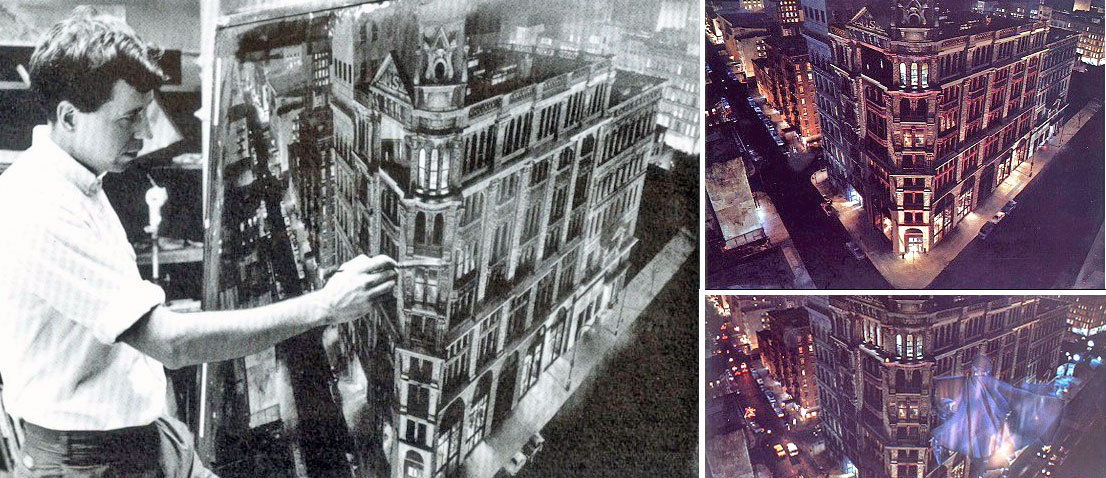
One of the greatest matte painters Mark Sullivan painting this full screen shot of Sigourney Weaver’s apartment and cityscape around it from the movie Ghostbusters 2.

During early days Matte Paintings were made by artists on large sheets of glass using paints or pastels which then integrated with the live-action footage.

Through various techniques Matte Painters and Film Technicians used to combine a matte-painted image with live-action footage.

The painting part is static in the shot and movements are added into it through live action shot.

Filmmaker Norman Dawn made this Matte Painting technique popular in the film industry; Norman used to put black tape on a sheet of glass positioned between the camera and the scene he was shooting.

Then Norman would rewind the film and shoot a matte painting with new pictures which he wanted to include in a scene.


Traditional matte-painting shot from the movie includes Emerald City scene from the film The Wizard of Oz (1939).


Another one is from the movie Citizen Kane (1941) Charles Foster Kane’s Xanadu.

These films used actual paintings on sheets of glass to create the illusion.

Even the most influential filmmaker Alfred Hitchcock used glass pane matte paintings throughout the 40s and 60s in hid films like North by Northwest and The Birds.


Mary Poppins (1964) received Academy Award for Best Visual Effects and used matte painting extensively.

The entire background of many shots was a full frame of art and the live actors were fitted into it.

Artist Peter Ellenshaw was the main man behind creating the matte painting shots of this film.

Industrial Light and Magic (ILM) used many Matte Paintings to create incredible VFX for the movie Star Wars and Indiana Jones.


Christopher Evans painted many of Star War images like Darth Vader’s Imperial March.

ILM also created matte painting for the Raiders of the lost Ark which took almost three months to paint all the craters and boxes.

Advancements in computer graphics allowed matte painters to work on digital platform form the mid 1980s.


Christopher Evans created the first digital matte shot for the film Young Sherlock Holmes in 1985.

It showed CG animation of a knight leaping from a stained-glass window; Evans painted the window in acrylics and then scanned the painting into Lucas Films Pixar system for further digital corrections.

Traditional matte painting along with digital compositing was used throughout 1990s.


The last scene of an airport runway in the movie Die Hard 2 (1990) used digitally composited live-action footage with a traditional glass matte painting which was photographed and scanned into a computer.


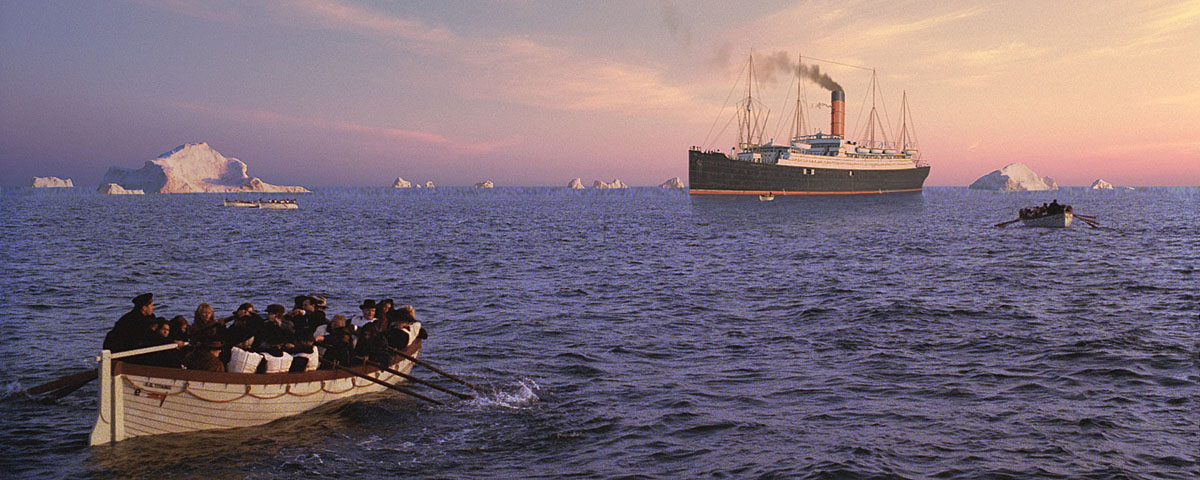
The last hand painted matte painting was used in James Cameron’s 1997 film Titanic.

The above Titanic shot was crafted by Christopher Evans and the last example of oil matte paintings.

Matte Painting was a standard film technique throughout 20th century which appeared in major films before digital VFX came and became the new standard.


Matte Painters work under the supervision of a film’s art director.

Matte Painters are the talented and creative people behind the photo-realistic landscapes and interior or exterior environments which are impossible to get on a real film set or location.

Matte Painters are provided with a description or desired mood of the scene.

Then they create a representation of the scenery either by hand or in computer software like Photoshop or illustrator.

Finally the art director or film director approves the desired scene created by the matte painter.

Matte Painters rely on the basic brushes, getting hold of the brush tool and using it accurately is art.

Motion Picture production has now moved to blue and green screens but the traditional matte painting techniques are still applied to modern filmmaking.

Matte paintings are no longer two dimensional images, 3dimensional sets and backgrounds are created digitally.

Pastel drawings or actual paintings can be used as concept references or scanned into computer as a base for visual setting to be digitally altered or layered with other images to create the final setting.

Modern Matte painters use different number of digital painting techniques such as scanning photographs, images of handmade artwork, collage image and others.

This technique has provided a great opportunity to the film makers as they can add their imagination into the live-action.


Matte Paintings are even turned into actual canvas backdrops in the film like Harry Potter and the Prisoner of Azkaban; six 100 foot canvases were stitched together and placed behind the set.

A Matte Painter need to have solid art skills to create photorealistic backgrounds for film; matte artist should have a depth knowledge regarding colour, texture, shapes and everything about art.

Knowledge about common digital art programs like Photoshop and Illustrator with 3D modeling programs are necessary in case of digital Matte painting.

Matte Painting has gone through many changes in the last century but it is still surviving as a film technique and there is a plenty of demand for talented matte painters with a vision and sense of imagination.

If you have traditional drawing and painting skills with 3D knowledge then you will be in demand in film industry as Matte Painters.

So, viewers be a part of our MAAC Centres Kolkata and explore the world of art.

Sunday, 5 May 2019

Stan Lee The American Comic Book Writer

In today’s blog we will take you into the life of an amazing person Stan Lee whose work created history in the world of comics, animations and films.


Stanley Martin Lieber (1922-2018) or Stan Lee is best known for his work with Marvel Comics.

Stan Lee used to enjoy writing from his youth and used do to part time job as writing obituaries for news service.

In 1950s DC Comics editor Julius Schwartz revived the superhero archetype and experienced huge success with its update version of the ‘Flash’ (superhero) and later with super-team ‘Justice League of America’.

Inspired by that publisher Martin Goodman assigned Lee to come up with a new superhero team.

Lee acted on that advice, giving his superheroes a flawless humanity.

Lee came up with complex, naturalistic characters who could have bad tempers, fits of melancholy, worried about paying their bills and other issues.


Along with artist Jack Kirby, Stan Lee created the first superhero team The Fantastic Four (1961) based on a previous Jack Kirby superhero team ‘Challengers of the Unknown’ published by DC Comics.

Fantastic Four is about four astronauts who gain superpowers after exposure to cosmic rays during a scientific mission to outer space.

The members of Fantastic Four included Mister Fantastic, Invisible Woman, Human Torch and Thing.

The Fantastic Four has been adapted into other media also such as animated series and live-action films.

The immense popularity of The Fantastic Four series made them major forces in the Comics world.

Working with artist Kirby, Lee co-created superheroes like the Hulk, Thor, Iron Man, Black Panther and X-Men.


The Hulk character first appeared in the debut issue of ‘The Incredible Hulk’ in 1962.

Hulk is a green-skinned, big and muscular humanoid possessing a vast degree of physical strength and his alter ego Dr. Robert Bruce Banner, a physically weak, socially withdrawn and emotionally reserved physicist, both are surviving as independent personalities and resenting of the other.

Stan Lee created Hulk inspired by a combination of Frankenstein and Dr. Jekyll and Mr. Hyde.


Fictional Superhero Thor appeared in Marvel Comic book ‘Journey into Mystery’ in 1962.

It also appeared in animated television, movies, video games, clothing, toys and trading cards.


The fictional superhero Iron Man character first appeared in the book ‘Tales of Suspense’ by Marvel Comics (1963) and got its own title Iron Man in 1968.

Marvel Comic character Iron Man has been adapted for several animated TV shows and films.

The Iron Man character is portrayed by Robert Downey Jr in the live action film Iron Man (2008).


Superhero Black Panther is the first African in mainstream American Comics before other African-American superheroes like Falcon, Blade and Luke Cage.

Black Panther first appeared in Fantastic Four (1966) in the Silver Age of Comic Books.


X-Men are a team of fictional superheroes first appeared in Comic: The X-Men in 1963.

It too appeared in television shows, films and video games.

A particular feature of Lee’s comic-book heroes is that they combine superhuman powers with human insecurities and emotions.

In 1972 Lee became publisher and editorial director of the Marvel group.


Ant-Man was created by Larry Lieber, Jack Kirby and Stan Lee, first appeared in ‘Tales to Astonish’ published by Marvel Comics in 1962.


With artist Bill Everett, Lee created superhero Daredevil.


Along with American Comic artist Steve Ditko, Stan Lee created fictional superhero Doctor Strange and Marvel’s most successful character Spider-Man.


Doctor Stephen Vincent Strange or Dr. Strange appeared in ‘Strange Tales’ in 1963. Doctor Strange performs as a Sorcerer Supreme, the prime protector of Earth against magical and mystical threats.

Dr. Strange was created during the Silver Age of Comic Books, inspired by stories of ‘Black Magic’ and ‘Chandu the Magician’ to bring a different kind of character and themes of mysticism to Marvel Comics.


In the comic book Amazing Fantasy (1962) Spider-Man first appeared.

Comic book The Amazing Spider-Man was the long lasting one.

Spider-Man appeared in a number of movies, television shows and video game adaptations set in the Marvel Universe.

Stan Lee, Kirby and Ditko adopted a collaborative workflow that came to be known as “the Marvel method”.

By this technique artists could provide more inputs on story plotting and it allowed Marvel to produce new content at an amazing rate.


Stan Lee and Kirby gathered several of their newly created characters together into the team title The Avengers in Stan Lee’s Style.

After the reinvention of the Superheroes in 1960s, Marvel Comics got new audience other than the kids.

While coming up with new methods of comics storytelling and characterization, addressing more serious themes and in the process keeping and attracting readers in their teens and beyond.

Lee wanted his fans to think of the comics creators as ‘Friends’.

Lee introduced the practice of regularly including a credit panel on the splash page of each story, naming not just the writer and artist but also the inker and letterer.

Regular news about Marvel staff members and upcoming storylines was presented on the Bullpen Bulletins page, which was written in a friendly, chatty style.

Stan Lee would brainstorm a story with the artist and then prepare a brief synopsis rather than a full script.

On the basis of the synopsis, the artist would fill the allotted number of pages by determining and drawing the panel-to-panel storytelling.

After the work of pencils by artists, Stan Lee would write the word balloons and captions, and then oversee the lettering and colouring.


During 1960s, Lee wrote script, directed and edited most of Marvel’s series, reviewed the letters pages, wrote a monthly column called Stan’s Soapbox, and wrote endless promotional copy, often signing off with his trademark motto, Excelsior!


With Gene Colan, Lee created the Falcon, first African-American superhero in ‘Captain America’ in 1969 for the comics.

In the year 1972, Lee stopped writing monthly comic books and became Publisher.

Stan Lee moved to California in 1981 to develop Marvel’s TV and Movie properties, he made brief appearances in Marvel film adaptations and other movies.

Therefore we see that Stan Lee’s Superheroes won the heart of millions in the past decades.

With the help of Animation you can bring any Comic character into the Audio-Visual platform.

So what are you waiting for, if you are a die-hard fan of cartoon characters and have a passion for drawing then come and join us.